In this post, you will learn about the protective practices you should adopt for healing and protection from black magic and harmful spiritual influences. We sincerely request that you read every line of this post carefully and thoughtfully so that you may truly understand the path toward spiritual protection and healing.
It is important to understand that, according to the observations and experiences of many spiritual scholars and saints, Muslims who become affected by black magic and harmful spiritual forces are often those who remain distant from Hisar-e-Nabwi.
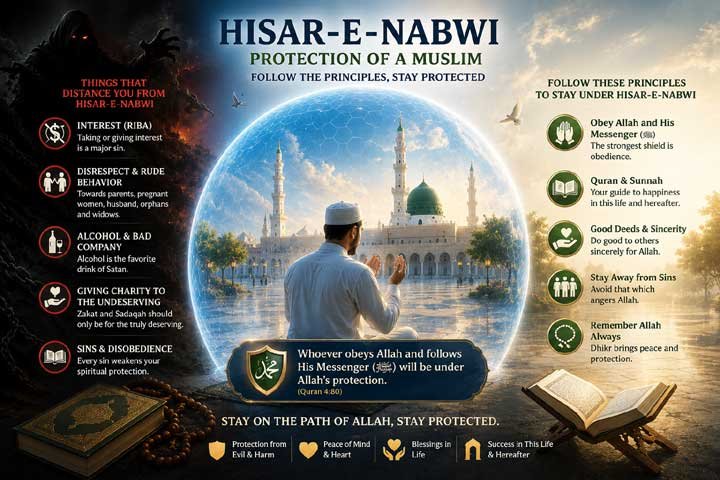
Hisar-e-Nabwi refers to five important Islamic practices that every Muslim should understand and follow. While the exact term Hisar-e-Nabwi is not directly mentioned in the sayings of the Prophet, its foundations and principles are derived from authentic Islamic teachings and traditions.
Those who sincerely follow these five principles are believed to develop a form of spiritual protection around themselves, which helps safeguard them from harmful influences such as evil intentions, black magic, envy, negative spiritual forces, and enemies. However, people who neglect these teachings may, at some point in life, become more vulnerable to difficulties caused by harmful influences and negativity. Therefore, we encourage you to understand these teachings and apply them in your daily life.
It is also believed by many spiritual teachers that spiritual remedies alone may not be enough unless a person strengthens their own spiritual discipline and connection with Islamic teachings.
Some elders and spiritual scholars believe that Hisar-e-Nabwi is a natural spiritual protection granted to every Muslim from birth. This protection helps guard a person against negative spiritual influences, envy, and harmful intentions. However, over time, worldly desires and harmful habits may weaken this spiritual protection, making a person more spiritually vulnerable.
The Five Principles of Hisar-e-Nabwi:
Prayer (Salah)
Charity and Zakat
Avoiding Interest (Riba)
Staying Away from Alcohol
Avoiding Bad Behavior and Disrespect
Most Muslims are already familiar with these five teachings. However, the deeper wisdom, spiritual observations, and practical effects of neglecting them are often less understood. In this post, we will explain important details and insights regarding these principles and how they may influence a person’s spiritual well-being.
Missed Prayers (Qada Salah)
The first principle of Hisar-e-Nabwi is prayer (Salah). When a Muslim performs prayer with sincerity, love, and consistency, it is believed that they remain within the spiritual protection of Hisar-e-Nabwi. However, when a person intentionally neglects or misses their obligatory prayers, many spiritual teachers believe this weakens their spiritual protection and may leave them more vulnerable to hardships and negative influences.
According to Islamic teachings, prayer is one of the greatest acts of worship and spiritual protection for a believer. A sincere connection with prayer strengthens faith, discipline, and closeness to Allah. It is often believed that a person who remains committed to prayer develops spiritual strength and inner peace that helps protect them from negativity, harmful influences, and life’s spiritual challenges.
Prayer is not optional for a Muslim; rather, it is regarded as the foundation of worship in Islam. However, true prayer is not only about standing, bowing, and prostrating. A complete and meaningful prayer is one that also transforms a person’s character and daily life.
Prayer teaches a Muslim to:
Give charity (Sadaqah) and Zakat to those in need
Avoid interest-based dealings (Riba)
Stay away from alcohol and immoral behavior
Treat others with kindness and good manners
It is believed that when a Muslim sincerely follows the values taught through prayer, they strengthen their spiritual protection and moral character. For those struggling with fear, negativity, or spiritual distress, reconnecting with sincere prayer can bring peace, strength, and a renewed sense of closeness to Allah.
Prayer is the first and most important principle of Hisar-e-Nabwi. Therefore, if you wish to receive the spiritual blessings associated with this protection, it is important to strengthen and perfect your prayer. According to this understanding, four essential principles should be practiced throughout life alongside prayer:
Charity and Zakat
Avoiding Interest (Riba)
Staying Away from Alcohol
Avoiding Bad Behavior and Disrespect
Give Charity and Zakat Only to the Truly Deserving
However, if a Muslim gives charity and Zakat to someone who is not deserving, or does not give charity and Zakat at all, then in both situations they are believed to move away from Hisar-e-Nabwi. According to this belief, distancing oneself from Hisar-e-Nabwi may lead to different kinds of hardships, spiritual problems, and vulnerability to harmful influences.
Giving charity and Zakat to an undeserving person does not bring spiritual benefit. Instead, it may deprive a person of blessings and, in some cases, may even become a cause of sin.
For example, if you give someone money as charity and that person later uses your charity money to buy cigarettes, then according to this understanding, you may also share responsibility because the money was used for something considered harmful or forbidden in Islam.
Some people donate charity to religious organizations, but it is believed that some organizations may misuse such donations to promote division or sectarianism. Therefore, if a person knowingly gives charity or Zakat to organizations that spread conflict and division in religion, they may be held accountable for supporting such activities.
If a person is healthy, physically able, and capable of earning a living, yet receives charity and Zakat unnecessarily, some believe this may discourage self-reliance and contribute to dependency within society.
You may wonder: “If I gave charity with good intentions, then what the receiver does afterward is not my responsibility.” However, according to this understanding, if we truly reflect upon the purpose of charity and Zakat, many such questions can be better understood.
Some people may find these ideas difficult to accept and think that it is better not to give charity at all. However, it should be remembered that Islam does not discourage charity and Zakat. Rather, it discourages giving them to those who are not truly deserving. Giving charity to deserving people is believed to protect Muslims from hardships and misfortunes, while careless giving may not bring the intended spiritual or worldly benefits.
According to some spiritual teachers, giving charity and Zakat to undeserving individuals—or knowingly misusing charity money—is considered an act that pleases harmful influences and distances a person from spiritual blessings.
In this regard, our spiritual teacher Raza Bhai once shared a personal experience. Every month, a woman would come to him crying and asking for financial help. She appeared to have marks of abuse on her arms and face. Feeling sympathy, Raza Bhai often helped her beyond his financial ability.
This continued for several months until one day Raza Bhai began to feel that perhaps something was not right. He decided to quietly investigate the matter with a few trusted companions. They followed the woman until evening and discovered that she had traveled to another city and entered a shop. Outwardly, the shop sold cold drinks, but in reality, illegal alcohol was also being sold there. It appeared that the woman had purchased alcohol, and after further investigation, this was found to be true.
Later, they followed the woman to a house and discovered that it belonged to her husband, who was allegedly involved in gambling activities. They also learned that several women were being used to emotionally influence people into giving charity and money through deception.
This incident deeply affected Raza Bhai, and afterward, he became more careful about giving charity without proper verification. However, he still continued helping truly deserving people in private and with sincerity.
It should be remembered that if Muslims wish to reduce poverty in society, then charity and Zakat should reach those who genuinely deserve them. According to this belief, giving charity to undeserving people may bring difficulties and remove blessings from life, while wise and responsible giving can become a source of goodness and protection.
Protect Yourself from Taking and Giving Interest (Riba)
The third principle of Hisar-e-Nabwi is staying away from Riba (interest/usury). If a person knowingly or unknowingly uses money earned through interest or benefits from something purchased through interest, then because of this, they move away from Hisar-e-Nabwi. According to this belief, distancing oneself from Hisar-e-Nabwi means that at some point in life, a person may become vulnerable to attacks from harmful spiritual influences, enemies, jinn, evil forces, or black magic, and escaping from such difficulties may not be easy.
Taking interest and giving interest are both sins, and there are strict sayings in Islamic teachings regarding this matter.
Some people take interest-based bank loans to build homes, some use them to start businesses, while others borrow money on interest simply for comfort and luxury. Whatever the purpose may be, according to this understanding, involvement in interest brings a form of misfortune into life that can lead to serious hardships and difficulties.
Some people comfort themselves by thinking that they will stop dealing with interest once their business becomes successful. Others believe they will borrow money on interest only one time and never again. However, according to this belief, Satan also whispers the same thing—that it will only happen once. But once a person becomes involved in interest-based dealings, they may sink into it deeply, and in some cases, they are unable to escape this trap until death.
It should be remembered that everything purchased with interest-based money can become a source of severe hardship in both this world and the Hereafter.
From a spiritual perspective, some elders say that the misfortune caused by interest can be even more dangerous than the effects of black magic and may not leave easily. According to this understanding, even a single penny earned through interest may distance a person from Hisar-e-Nabwi.
Therefore, if you are suffering from black magic or harmful spiritual influences, then you must stay away from interest-based dealings.
The Effects of Disrespectful Behavior
Another major reason for becoming distant from Hisar-e-Nabwi is showing disrespect toward parents, pregnant women, a husband, orphans, and widowed women. According to this understanding, if a Muslim man or woman behaves disrespectfully toward their parents, pregnant women, husband, orphans, or widowed women due to anger or arrogance, they immediately move away from Hisar-e-Nabwi.
According to this belief, distancing oneself from Hisar-e-Nabwi may leave a person vulnerable to harmful spiritual influences, and among these, black magic is considered one of the most significant.
The Effects of Alcohol
Alcohol is considered one of the things strongly discouraged in Islam and is often described as something that leads a person toward harmful influences and away from righteousness. According to this understanding, if a Muslim consumes alcohol or regularly sits in the company of people who drink alcohol, they may distance themselves from Hisar-e-Nabwi.
According to this belief, moving away from Hisar-e-Nabwi may bring a person closer to negative spiritual influences and weaken their spiritual protection.